Drive-up storage park finance
Funding for single-storey drive-up self storage parks, where customers park directly at the door of their own storage unit.

Funding drive-up parks
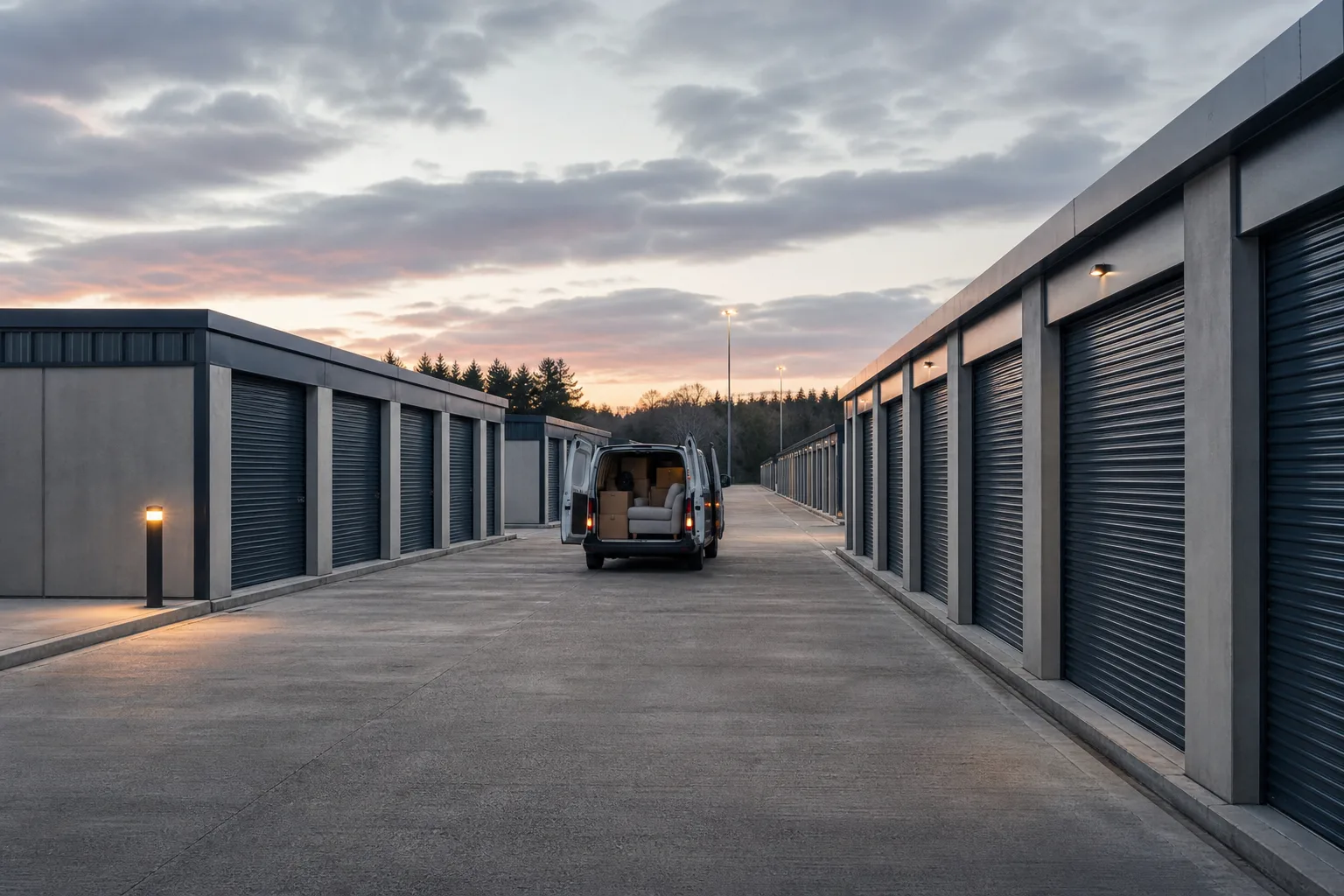
A drive-up storage park is self storage at its most direct: rows of single-storey units on a secure site, each with its own roller door, so customers drive up to their storage unit and load straight from the vehicle. The format is common on edge-of-town land where plots are larger and cheaper.
The economics are a fair trade. Drive-up units achieve a lower rate per square foot than indoor storage units because the specification is simpler, but the build cost per square foot is lower too. For lenders the park is a trading self storage business like any other, with development finance funding the build and a commercial mortgage taking over once the income is proven. We arrange both ends of that journey.
What we fund
- Rows of single-storey steel units with individual roller doors
- Edge-of-town and roadside sites with generous circulation space
- Unit mixes from small household units to large business and trade units
- Hybrid sites pairing drive-up rows with container or open storage
- Phased schemes adding rows as occupancy fills
Indicative terms
- Typical lot size (indicative)£750k to £8m
- Development funding (indicative)Up to ~65 to 75% of cost
- Trading LTV (indicative)Up to ~60 to 70% of valuation
- Term rates (indicative)From around 6%
Indicative only. Terms vary by lender, asset and borrower and are not an offer of finance.
Funding a drive-up park from land to term debt
We arrange the finance for a drive-up scheme in the same staged way as any storage development, scaled to the simpler build. The land purchase runs on bridging or within a development facility, with development finance sized indicatively up to 65 to 75 percent of total cost. Because construction is quick and often phased, later rows are drawn down as earlier ones let. Through the occupancy build-up the debt is serviced or rolled against the plan, and once the park's rental income is established we refinance onto a commercial mortgage sized on the trading valuation, indicatively up to 60 to 70 percent loan to value at term rates from around 6 percent. We arrange and introduce; we are not the lender.
How lenders underwrite drive-up storage income
Lenders underwrite a drive-up park as a trading business: EBITDA, occupancy and the net achieved rate per square foot are the numbers that size the debt, exactly as for an indoor store. The format-specific questions sit around the rate and the catchment. Achieved rates on drive-up units run below indoor storage, so lenders test that the business plan prices realistically for the local market, and they look at the depth of trade and small-business demand, which drives a larger share of lettings in this format than in indoor stores. The simpler build helps the credit: cost overrun risk is lower, the programme is short, and a phased scheme can show real letting evidence before the later rows are even built.
The market for drive-up storage parks
Drive-up parks occupy a practical, durable corner of UK self storage. The format dominates where land is available and customers are vehicle-based, and its tenant mix of tradespeople, small businesses and households gives it local, repeat demand. Because the build is simple and the operating model lean, parks run profitably at sizes that would not support a staffed indoor store. Exits follow the standard storage routes: a refinance once trading matures, a sale of the trading business, or a hold on the income, and well-run parks attract the same consolidator and investor interest as other trading stores.
Finance that suits this asset class
- Development financeFunding land and phased unit rows against total project cost.
- Commercial mortgagesTerm debt on the park's trading income once occupancy is proven.
- Equity and JVCompleting the capital stack where operator equity is the constraint.
Useful calculators
Related guides
Fund a drive-up parks deal
A view on fundability within one working day.
What does drive-up mean in self storage?
Drive-up storage means the customer can bring a vehicle directly to the door of their own unit. Instead of carrying goods through a reception and taking a lift, the customer drives along the row and loads or unloads at their own roller door.
Physically, a drive-up park is rows of single-storey steel units with individual doors, wide circulation roads, gated access and CCTV. Unit sizes typically run from small household units up to large spaces used by trades and businesses for stock, tools and equipment. For funding purposes the definition matters because it pins the asset: a drive-up park is a trading self storage business on its own secure site, not a let industrial estate, and lenders that understand storage underwrite the rental income accordingly.
How much does a drive-up storage park cost to build?
The format's advantage is a genuinely lower build cost per square foot than an indoor store. Single-storey steel unit rows need no lifts, corridors, internal climate systems or multi-storey structure. The trade-off is land: drive-up needs more of it per lettable square foot, since circulation roads and single-storey massing spread the units out.
We fund against the evidenced cost stack rather than rules of thumb: the land, groundworks, the unit rows, surfacing, fencing, lighting and security, plus contingency. Development finance indicatively advances up to 65 to 75 percent of that total cost, with the operator's equity and any land value held covering the balance.
How does drive-up rental income compare with indoor stores?
Drive-up units achieve a lower rate per square foot than indoor storage units. Customers pay a premium for climate-managed, staffed indoor space, and drive-up offers cheaper space with better vehicle access. A storage business running both formats will price them differently in the same town, and lenders expect that differential reflected honestly in any drive-up business plan.
Lower rates do not mean weaker economics, because the cost side moves further. Build cost per square foot is lower, staffing can be minimal, and there is little internal fabric to maintain. The result is that a well-let drive-up park can convert revenue into EBITDA at a strong margin, and EBITDA is what the debt is sized on. We present drive-up deals with the rate set against local drive-up comparables rather than indoor headline rates, so the lender's valuation assumptions survive diligence.
What finance fits a new drive-up scheme before it is trading?
A new park has no income, so the early funding is sized on cost and business plan. Development finance is the natural fit where land purchase and build are funded together, with drawdowns matched to the short build programme. Where the land needs securing quickly, ahead of full costings or planning, bridging finance from an indicative 0.75 percent per month buys the time, then rolls into the development facility.
Lenders want the demand case for the catchment, the proposed unit mix and pricing against local comparables, and a letting-up assumption that reaches stabilisation over a sensible horizon rather than a hopeful one. Where equity is the constraint on an otherwise sound scheme, mezzanine finance or an equity and joint venture introduction can complete the capital stack.
Can you remortgage a trading drive-up park?
Yes, and the remortgage is usually where the format's economics pay off. Once the park has an established trading record, a commercial mortgage can be sized at up to 60 to 70 percent of the trading valuation on an indicative basis, at term rates from around 6 percent, replacing development or bridging debt. Because the valuation reflects the storage business rather than bare land and steel, the refinance frequently releases equity above the original cost.
Operators remortgage to repay maturing facilities, fix a rate, release equity for the next site or the next phase of rows, or consolidate land and build debt into one facility. Debt service cover on the park's EBITDA is the test that sizes the loan, so the records of occupancy, achieved rates and costs need to be presentation-ready.
Worked example: phased drive-up park on edge-of-town land
Take an illustrative scheme: an operator buys two acres of edge-of-town land for £500k and plans 25,000 sq ft of drive-up storage units across three phases at a build cost of £1.75m, so £2.25m all-in. These figures are illustrative only, not a quote, and any real facility would be sized on the specific site, costings and valuation.
A development facility at 70 percent of cost advances around £1.575m across land and build, drawn in stages, with the operator funding roughly £675k of equity. Phase one opens within months of starting on site, and its letting evidence supports the drawdowns for phases two and three.
Suppose that by the end of year three the park is well let and producing around £400k of revenue with £260k of EBITDA. A trading valuation at that point might support a commercial mortgage at 65 percent loan to value, repaying the development facility and releasing equity, with debt service covered comfortably out of EBITDA.
From there the operator can hold the park on term debt, add rows if the site has spare density, or recycle the released equity into a second site with a trading record behind them.
Illustrative worked example only. Figures vary by lender, asset and borrower and are not an offer of finance.
Frequently asked questions
What does drive-up mean in storage?
Drive-up storage means each storage unit has its own external door at ground level, so customers can drive a vehicle directly to the unit and load or unload on the spot. A drive-up storage park is a secure site of single-storey unit rows built around that access.
Can a customer use a storage unit as a workshop?
Generally no. Storage units are let for storage, and working in a unit usually breaches the licence agreement, the site's planning use and the insurance position. That discipline matters to lenders, because a park let strictly for storage is a cleaner asset to underwrite.
Are drive-up parks cheaper to build than indoor self storage?
Per square foot, yes. Single-storey steel rows avoid the lifts, corridors and multi-storey structure of an indoor store, so the build cost per square foot is lower, though more land is needed per lettable square foot and achieved rates are lower than indoor units too.
What loan to value can a trading drive-up park support?
Indicatively up to 60 to 70 percent of a trading valuation once the park has an established income record, with the loan sized on debt service cover out of EBITDA.
Funding a drive-up parks asset?
Tell us about the deal and we will come back with a view on fundability and likely terms.