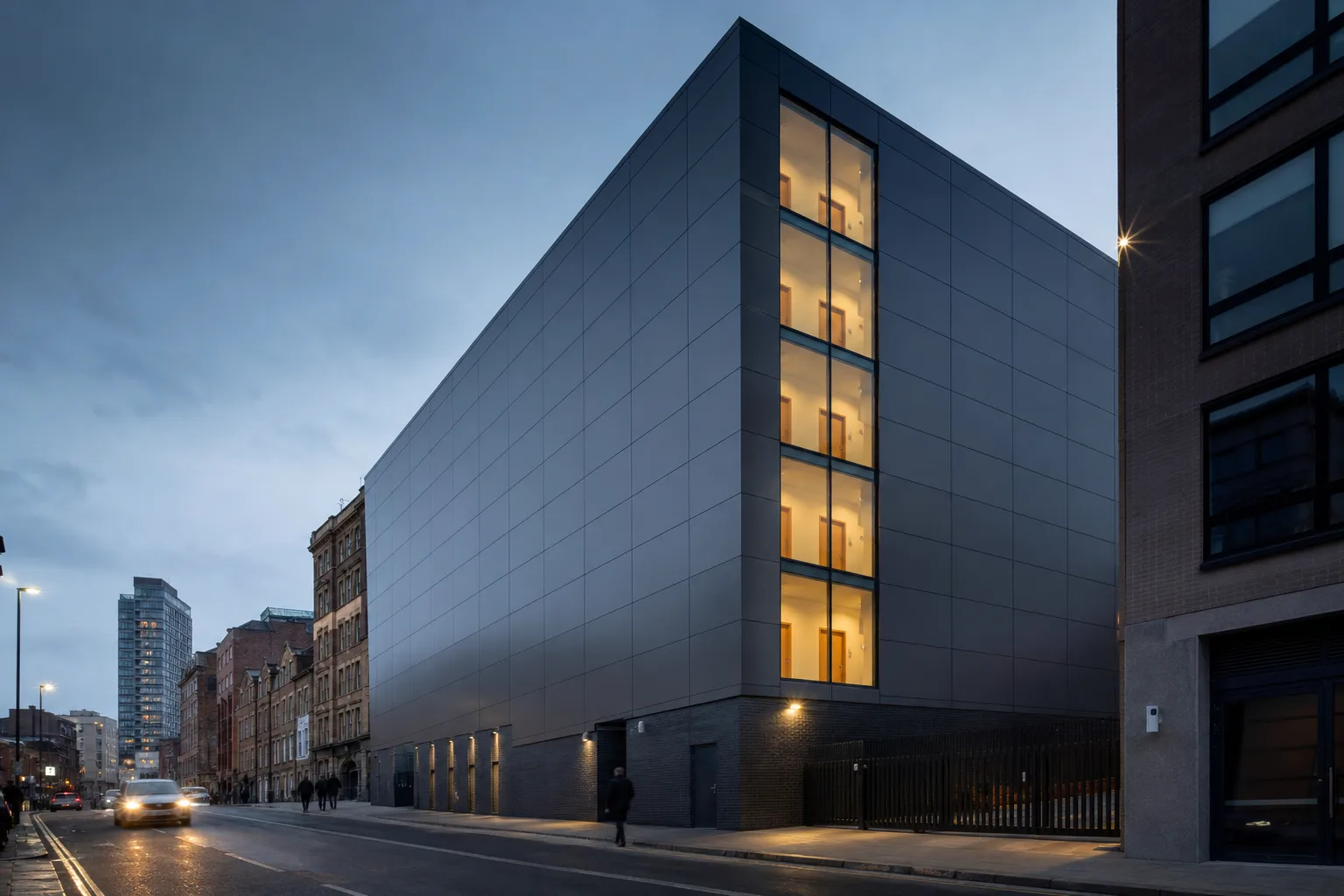
Multi-storey urban self storage finance
Funding for city-centre and inner-urban multi-level stores, from office and retail conversions to flagship purpose-built facilities.
Funding multi-storey urban
A multi-storey urban store is a self storage facility built or converted over several floors in a city-centre or inner-urban location where land is scarce and ground-level space is expensive. Going vertical is how operators put a meaningful amount of lettable storage into a catchment that could never support a sprawling single-level site, and it is why many of the most visible flagship stores in UK cities trade across three, four or more floors.
These stores serve customers within a 15 to 20 minute drive-time catchment, drawing on dense residential and business populations, and they typically achieve higher rates per square foot than edge-of-town stock. Many began life as offices, retail warehouses or light industrial buildings before conversion, while others are purpose-built. Lenders finance them against the trading income the storage business produces, sizing loan to value off a trading valuation rather than bricks and mortar alone, and we arrange that debt across acquisition, conversion and long-term hold.
What we fund
- City-centre and inner-urban stores trading over multiple floors
- Office, retail warehouse and industrial conversions to self storage
- Purpose-built flagship stores on arterial roads and ring roads
- Buildings with goods lifts, trolley access and reinforced floor loading
- Stores serving dense 15 to 20 minute drive-time catchments
Indicative terms
- Typical lot size£2m to £30m and above (indicative)
- Term LTVUp to 60 to 70 percent of trading valuation (indicative)
- Term ratesFrom around 6 percent (indicative)
- Development / bridgingFrom around 8 percent / from 0.75 percent per month (indicative)
Indicative only. Terms vary by lender, asset and borrower and are not an offer of finance.
Financing a multi-storey urban storage facility
We arrange finance across the full life of an urban store. For a trading facility with established occupancy we source term debt and commercial mortgage-style facilities priced off EBITDA, net achieved rate per square foot and debt service cover. For a conversion of an office or retail building we arrange development finance against build cost, then bridging or stabilisation debt while occupancy builds, before moving the operator onto longer term debt once the store is trading at a stabilised level. We act as arranger and introducer to lenders, not as a lender ourselves, and we present each store the way storage credit teams underwrite it.
Which lenders fund multi-storey urban stores
Urban multi-level stores attract the widest lender audience in the sector. High street banks, challenger banks and debt funds all lend against established trading stores, and institutional and REIT interest is strongest in exactly this kind of asset, which supports liquidity and gives lenders confidence in the exit. Underwriting centres on the trading performance of the storage business: EBITDA, the occupancy build-up curve, net achieved rate per square foot and the depth of demand in the drive-time catchment. On conversions, lenders also scrutinise the building itself, since lift capacity, floor loading and ceiling heights decide how efficiently upper floors can be let and serviced.
The market for urban self storage stores
Multi-storey urban stores sit at the most institutional end of the UK self storage market. Land scarcity in city centres limits new supply, dense catchments support pricing power, and the listed operators and institutional investors compete hardest for exactly this stock, which keeps the buyer pool deep when a store or its income comes to market. A well located urban facility with stabilised occupancy is among the most liquid assets in the sector, and that liquidity underpins both the loan to value lenders will advance and the refinance and sale routes available at the end of a hold. Conversions that have proven their trading performance are valued on the same basis as purpose-built stock, so the upside from buying a building cheaply and converting it well accrues to the operator.
Finance that suits this asset class
- Acquisition financeBuying a trading urban store or a building to convert.
- Development financeFunding conversions and purpose-built multi-storey schemes.
- Commercial mortgagesTerm debt against stabilised trading income on an urban store.
Useful calculators
Related guides
Fund a multi-storey urban deal
A view on fundability within one working day.
How much can you borrow against a multi-storey self storage store?
Borrowing on a multi-storey urban store is driven by trading income rather than vacant possession value. For an established storage business with stabilised occupancy, lenders will typically advance up to 60 to 70 percent of a trading valuation, which reflects EBITDA and the quality of the income rather than the bare building. Indicative lot sizes for urban stores run from around £2m for a smaller inner-urban facility to £30m and above for a flagship store in a major city.
The exact advance turns on how mature the income is. A store that has traded through several years at stable occupancy with a proven net achieved rate per square foot supports the top of the range, while a recently opened store still building occupancy is sized more cautiously, often on a bridge or stabilisation facility until the trading record is established. We size the debt against the figures lenders actually test, which means presenting management accounts, occupancy history and rate data rather than a simple bricks and mortar valuation.
Lot size also shapes the lender pool. Larger urban stores draw banks and debt funds competing on price, while smaller stores may suit challenger banks and specialist lenders. We match each deal to the lenders most active at that size so the facility reflects a realistic read of both the trading income and the value.
Why do urban stores achieve higher rates per square foot?
City-centre and inner-urban stores draw customers from dense residential and business catchments, typically within a 15 to 20 minute drive time, where households move more often, live in smaller homes and pay more for space of every kind. That demand profile lets urban storage units achieve materially higher rates per square foot than comparable edge-of-town stock, and it is the foundation of the investment case for going vertical on expensive land.
Scarcity reinforces pricing. Land in inner-urban locations rarely comes forward for storage use, planning is competitive and existing buildings suitable for conversion are limited, so a trading store in a strong catchment faces less new supply risk than an edge-of-town site surrounded by developable land. Lenders recognise this when they underwrite the durability of the rate per square foot, and we present catchment and competition analysis as part of the case for the loan.
Customers also ask what self storage costs per month, and in urban stores the answer is more than the regional average, which is precisely the point for a funder. Higher achieved rates on the same operating cost base flow through to EBITDA, and EBITDA is what the debt is sized against.
How do lenders underwrite trading income on a multi-level store?
Lenders underwrite a multi-storey store as an operating business secured on property. The core metrics are EBITDA, occupancy, net achieved rate per square foot and debt service cover on trading cash flow. A new store typically takes three to five years to stabilise occupancy, so the stage of that build-up curve determines whether the deal is funded as a stabilised term loan or as transitional debt with a refinance once the income matures.
The building itself is tested for how well it supports trading across floors. Goods lifts, trolley routes, floor loading and ceiling heights all affect how lettable and serviceable upper floors are, and a store where upper levels let slowly or at heavy discounts will see that reflected in the valuation. We assemble the trading pack, the building specification and the catchment evidence so the lender can underwrite the whole operation rather than just the postcode.
Can you finance a conversion of an office or retail building to self storage?
Yes, and conversions are one of the most common routes into urban self storage because suitable land for new building is so scarce. Former offices, retail warehouses and light industrial buildings in strong catchments convert well where the structure supports storage floor loading and a goods lift can be installed. We arrange development finance against acquisition and conversion cost, with indicative pricing from around 8 percent, sized off the cost plan and the projected stabilised trading value.
Lenders on a conversion test three things: the building's physical suitability, the planning position, and the credibility of the occupancy build-up assumptions. Structural capacity for storage loads, lift provision and ceiling heights decide how much lettable area the conversion really yields, while planning consent for storage use needs to be in place or clearly achievable. The revenue case rests on demand within the drive-time catchment and the rates achieved by competing stores.
Once the conversion completes and the store opens, the operator typically carries the facility through the early trading period, sometimes with bridging from around 0.75 percent per month if the development debt needs replacing before stabilisation, then refinances onto term debt once occupancy and EBITDA support a full trading valuation. We plan that whole sequence at the outset so each stage of the capital structure has a clear route to the next.
Can you refinance a multi-storey storage business?
Yes. We refinance trading urban stores onto new term debt to release equity created by occupancy growth and rate improvement, to replace development or bridging debt after stabilisation, or to reset a maturing facility. Because the loan is sized against a trading valuation, a store whose EBITDA has grown since the last facility can often support a materially larger advance, which many operators recycle into their next site.
Timing matters. A refinance taken once the store has demonstrated stabilised occupancy through a full trading cycle secures keener pricing than one taken mid build-up, because the lender can underwrite proven rather than projected income. Indicative term rates start from around 6 percent for established stores at sensible leverage, and we present the trading history in the format storage lenders expect so the new facility reflects the real strength of the business.
Worked example: city-centre office conversion to self storage
Take an illustrative conversion of a four-storey former office building in a strong city-centre catchment, bought for £5m with a £4.5m conversion budget including fit-out, lifts and mezzanine works. A development facility at around 65 percent of total cost would advance roughly £6.2m, with the operator funding the balance of about £3.3m in equity. These figures are illustrative only, not a quote, and any real facility would be sized on the actual cost plan, planning position and projected trading performance.
The store opens with, say, 55,000 square feet of lettable storage units across four floors. Occupancy builds over three to five years toward a stabilised level, with the net achieved rate per square foot rising as introductory discounts unwind. During this period the operator might replace the development debt with a stabilisation facility or bridging at illustrative pricing from around 0.75 percent per month, sized against the improving trading income.
At stabilisation, suppose the store produces EBITDA that supports a trading valuation of £14m. A term refinance at 60 percent loan to value would raise £8.4m, repaying the transitional debt in full and returning a meaningful share of the original equity, with indicative term pricing from around 6 percent. Debt service cover on trading cash flow would be tested with headroom at that leverage.
From there the operator can hold the store on term debt, refinance again as EBITDA grows, or sell into a market where institutional buyers and the listed operators compete for stabilised urban stores. Every figure above is illustrative and intended only to show how the capital structure evolves from conversion through stabilisation to long-term hold.
Illustrative worked example only. Figures vary by lender, asset and borrower and are not an offer of finance.
Frequently asked questions
How is a multi-storey self storage store valued for lending?
On its trading income. Lenders size debt against a trading valuation built on EBITDA, occupancy and net achieved rate per square foot, not the vacant building. An established urban store with stabilised occupancy will typically support lending up to 60 to 70 percent of that trading valuation on an indicative basis.
Can I get finance to convert an office building into self storage?
Yes. We arrange development finance against acquisition and conversion cost, with indicative pricing from around 8 percent. Lenders test the building's floor loading and lift provision, the planning position for storage use, and the occupancy build-up assumptions for the catchment before they commit.
How long does a new urban store take to stabilise?
Most new self storage stores take three to five years to build occupancy to a stabilised level. Lenders fund that period with development, bridging or stabilisation debt, then refinance onto term facilities once the trading record supports a full trading valuation.
Why do lenders like city-centre self storage?
Dense 15 to 20 minute drive-time catchments support higher rates per square foot, land scarcity limits competing supply, and institutional and REIT demand for urban stores keeps the assets liquid. That combination gives lenders confidence in both the income and the exit.
Funding a multi-storey urban asset?
Tell us about the deal and we will come back with a view on fundability and likely terms.